

The green transition offers major economic and security benefits, but investment is being delayed by financial uncertainty, a lack of coordination, and fears that assets will lose their value.
Center for Macrofinance was founded to design the macrofinancial reforms that can accelerate investment and reduce the cost of the energy transition.
Our aim is to help Denmark regain a position of global leadership by making better use of the state’s low cost of financing and by planning more strategically. That will create a prosperous, clean and resilient society capable of inspiring other countries in practical terms.
The time has come to depart from the competition state model, predicated upon a non-strategic state with sparse attention to the energy supply, that was developed in Denmark in the wake of the oil crises in the 1970s. In its place we can and should become the world’s first green electrostate: a shared, long-term model for Danish prosperity founded on far-reaching electrification and on a cheap, secure, intelligent and green energy supply. With the renewable capacity it has already built, Denmark is well placed to lead — advancing competitiveness and security through cheap, self-supplied energy and through technological strengths in electrotechnology supply chains.
Where today’s energy system depends on fuel prices, tomorrow’s electrified energy system will depend above all on whether financing costs can be held down and the pace of the transition kept up. This is challenged, however, by substantial uncertainty and by coordination problems, as society’s production, transport, storage and consumption of energy all have to change at the same time. The electrification of society in particular is lagging behind.
Center for Macrofinance therefore works to shape an investment landscape that supports a rapid, structural transformation of society’s energy system. This requires reforms of energy policy, investment policy and industrial policy, in Denmark as well as in the EU.
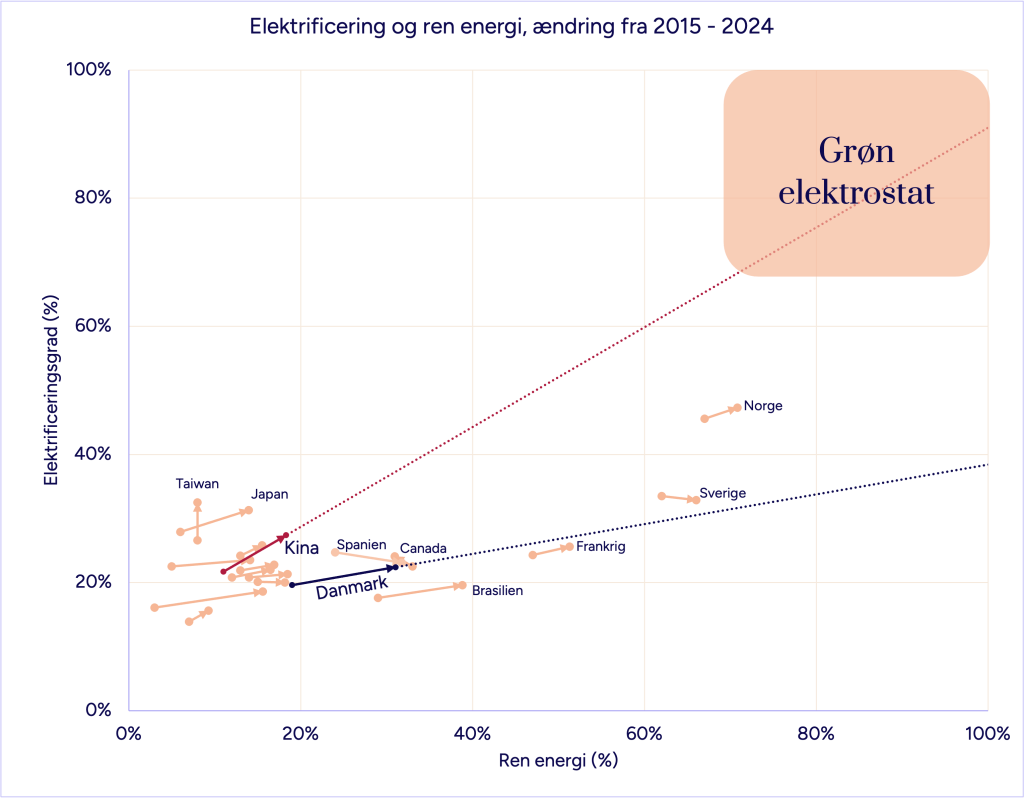
Green electrification is the central driver of future shared prosperity, resilience and competitiveness in Denmark and Europe.
Making Denmark the first green electrostate calls for macrofinancial reforms that can advance investment in the energy system of the future.
Investment is the driving force behind the transition to an electrified energy system. The energy system becomes more capital-intensive and thereby saves on fuel.
The price of financing, and the willingness to invest under uncertain conditions, therefore become more decisive for both the pace and the cost of the energy transition.
A modern fiscal policy makes sufficiently strategic investment in infrastructure, innovation and climate adaptation possible, while keeping an eye on preventing inflation and securing full employment. Europe is being held back by needlessly tight fiscal rules.
A wholehearted and ambitious green industrial policy ensures that electrification also becomes a source of technological sovereignty and new industrial strengths in Denmark and Europe. Europe must once again be the place where technology development, manufacturing and the energy transition go hand in hand.

Director
PhD in Innovation and Public Policy,
University College London